As the saying goes, “hindsight is 20/20”, meaning “things are clearer in retrospect”. 20/20 is a measure of a person’s visual acuity: you can see from 20 feet away what a “normal” person can also see from 20 feet away. In other words, your eyesight is normal (but you can still be colorblind, etc).
20/20 isn’t perfect vision; people with good eyesights often measure 20/15 or even 20/10 — they can see from 20 feet away what a “normal” person can only see from 15 or 10 feet away. D. R. on the other hand is severely nearsighted and measures worse than 20/200 without correction — without my glasses on, I can only see at 20 feet what “normal” people can see from 200 feet or even further away. 20/20 is the low end of “normal”; if you see at least 20/20, then an eye doctor wouldn’t prescribe you any glasses.
Decimals
What’s special about “20 feet”? Not much, really. It’s just been a standard testing distance since the Dutch ophthalmologist (= eye scientist) Herman Snellen came up with this measurement. In metric countries (i.e. outside the US), optometrists (= eye doctors) write 6/6 (meters) instead of 20/20. 6.00m = 19.7ft, but humans like round numbers.
There’s something weird about saying 20/20 or 6/6: you’re repeating yourself. If the standard testing distance is 20 feet for everybody, why not just say “my vision is 20”? In fact, why does it matter at all what the testing distance is? Doesn’t 10/10 or 40/40 mean exactly the same thing — “my eyesight is normal”?
For this reason, many other countries record visual acuity in decimals: 20/20 becomes 1.0, but so does 6/6, and 10/10, and 40/40. People with good eyesight might reach 2.0 (20/10, 6/3, etc.) while yours truly would measure less than 0.1 (worse than 20/200).
Conventions are hard to change; countries that use 20/20 or 6/6 notations won’t be converting to decimals any time soon. Interestingly, people in the UK don’t say “hindsight is 6/6”; this phrase is fixed thanks to Hollywood.
Designing an eye chart
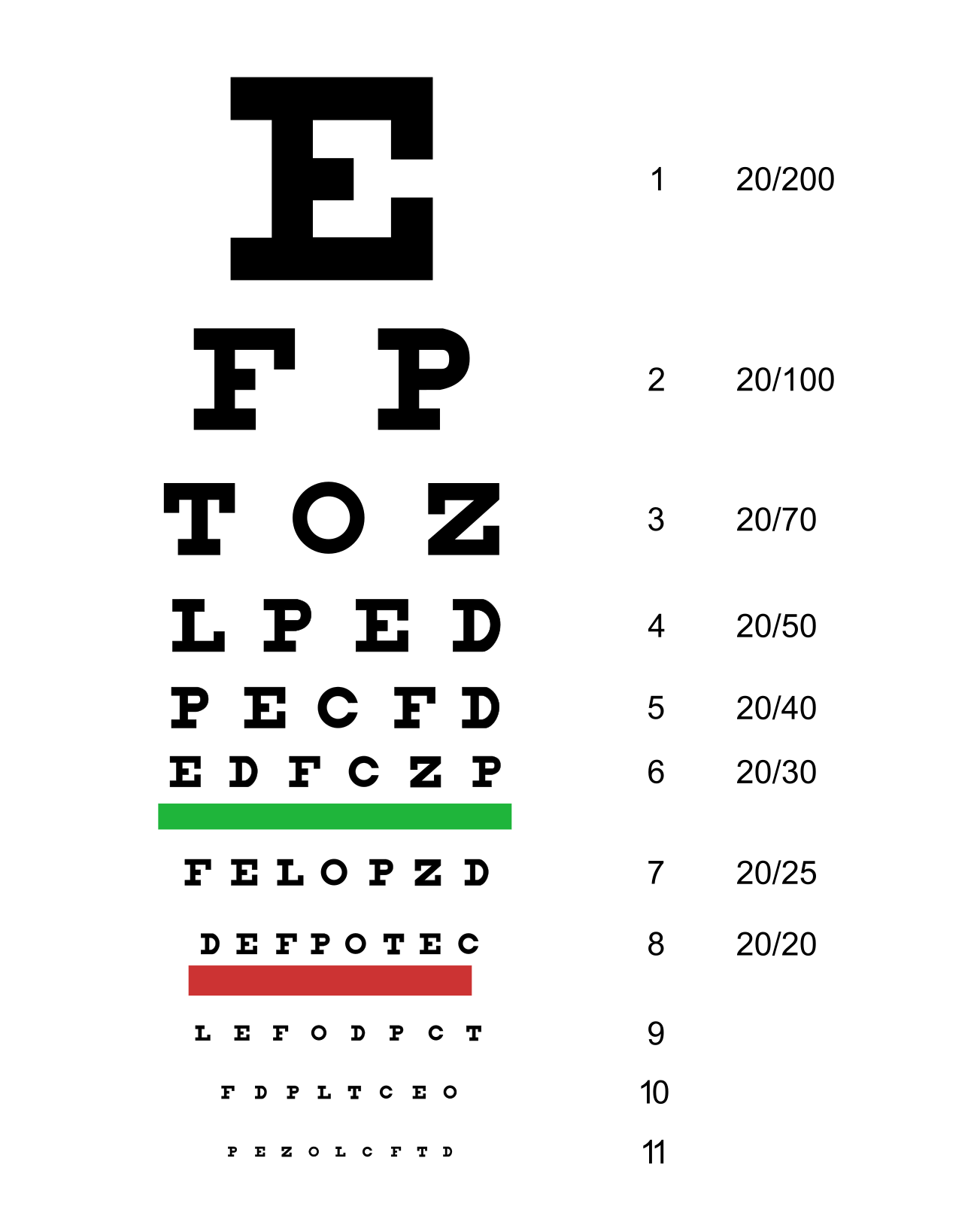
In English-speaking countries, eye charts often use uppercase letters. The smaller the letters you can make out, the better your eyesight is. But what if the patient is illiterate? Or is a child? Or has a medical condition making them unable to speak?
For this reason, many countries (esp. countries with non-alphabetical languages) use the Landolt C chart or the tumbling E chart, where the C- or E-shaped symbols (called optotypes) are rotated in different directions. Instead of reading out the letters, patients are asked to point in the direction of each symbol’s opening.
How many rows should there be on the eye chart? How big should the symbols be on each row? Eye charts often start at 20/200 (0.1) and stop a few rows after 20/20 (1.0). One might be tempted to progress linearly — first row at 0.1, next row at 0.2, then 0.3, then 0.4, etc. — and indeed, that’s what people did for a while. But then the doctors realized, it makes no sense for the first row (0.1) to be twice as big as the second row (0.2), but for the 9th row (0.9) to be only a smidge larger than the 10th row (1.0). We need the letter sizes to progress evenly.
Minimum Angle of Resolution (MAR)
Ultimately, what we’re measuring in visual acuity is at how small an angle a person can tell two strokes apart. A “normal” vision is defined as an MAR of 1 arc-minute (= 1/60 of a degree). If a letter is twice as big, but placed twice the distance away, it should be equally legible (or illegible) to the person taking the test.
So, for the chart to progress “evenly”, each row should be bigger than the next row by the same relative amount. For example, we can have 11 rows from 20/200 to 20/20, with each row 1.26 times the size of the next row (1.2610 = 10).
If you do the math, we’re essentially progressing linearly in the logarithms of the decimal scale. Instead of each row being 0.1, 0.2, 0.3 etc., we want to find x1, x2, x3, … such that lg x1 = 0.1, lg x2 = 0.2, lg x3 = 0.3, …
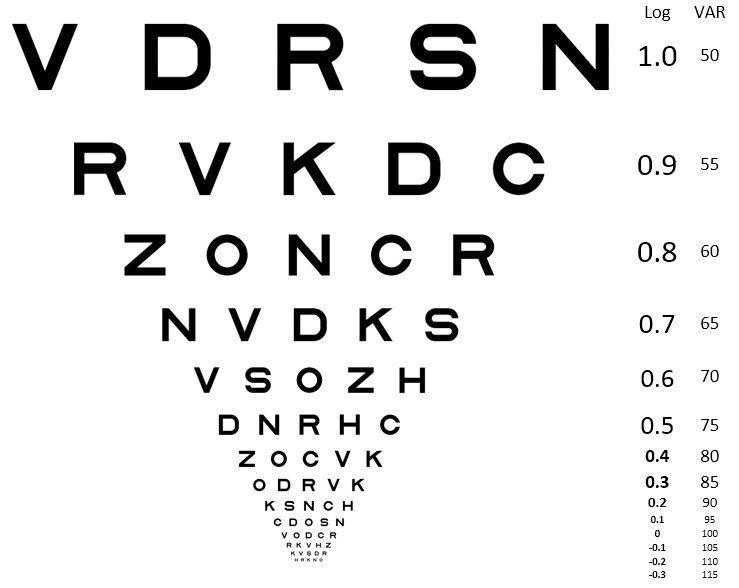
Or we can just record the logarithms themselves as the measurement. Indeed, in addition to fractions (20/20) and decimals (1.0), there’s also the LogMAR scale. However, LogMAR is taking the logarithm of the angle of resolution — remember, the smaller the angle, the better your eyesight. This results in a slightly counter-intuitive scale where better eyesights get lower scores (and the best eyesights are negative): 20/200 is 1.0, 20/20 is 0.0, and 20/10 is -0.3.
The 5-point scale
To address the counter-intuitiveness of the LogMAR scale, Prof. Miao Tianrong of China developed the 5-point scale of visual acuity, which is simply 5 - LogMAR. Outside of China, there’s also VAR (Visual Acuity Rating) or VAS (Visual Acuity Score) which is simply 100 - 50*LogMAR (but I can’t figure out who came up with it).
Here’s a comparison of all the notations and scales:
| Fractions (feet) | Fractions (meters) | Decimals | LogMAR | 5-point | VAR/VAS |
|---|---|---|---|---|---|
| 20/200 | 6/60 | 0.1 | 1.0 | 4.0 | 50 |
| 20/100 | 6/30 | 0.2 | 0.7 | 4.3 | 65 |
| 20/40 | 6/12 | 0.5 | 0.3 | 4.7 | 85 |
| 20/20 | 6/6 | 1.0 | 0.0 | 5.0 | 100 |
| 20/10 | 6/3 | 2.0 | -0.3 | 5.3 | 115 |
The 5-point scale progresses evenly with the angle of resolution, and goes up intuitively as the eyesight gets better. It’s by far the most common scale used in China, but is unfortunately virtually unheard of in other parts of the world.
Why not simply negate the LogMAR scale? Why the 5? Well, on the 5-point scale, scores below 3.0 (20/2000) have separate definitions: 2.0 = hand motion, 1.0 = light perception, etc. Therefore, 0.0 on this scale means not just a loss of functional sight, but a total loss of all light perception (you can’t tell if there’s a light shining in your face). Coincidentally, “5 points” was traditionally the best grade a teacher can give to a student on a test (like an “A” in the US or a “19/20” in France), so using 5.0 to mean 20/20 vision probably also made it easier to popularize this scale in China.
Yes, yes, Ty, I know A+ is a grade. A student can get 5+ too. That’s beside the point.
 D. R. Whispers